Doctors are not chimps.
A chimp will work for a grape—handing over a painted rock to a primatologist.
Getting doctors to change their prescribing behavior takes a bigger investment—like a 13-cent plastic pen with an Abilify logo.
In one study, a pharma rep spending just $13 on a doctor—like for a tuna sandwich and cappuccino in the hospital cafeteria—was associated with 94 days of brand loyalty: three months of the rep’s drug being prescribed instead of the generic.
It seems crazy that plastic trinkets and institutional tuna could sway doctors, but even the tiniest gift can cue our evolved drive for reciprocity and increase the prescribing of a certain brand of drug, notes George Washington University health policy professor Susan F. Wood.
“Free” drug samples likewise warp doctors’ prescribing practices, significantly increasing the doctor’s prescriptions of the promoted drug.
Your doctor likely believes they’re immune to all this pharma bribe-fluencing—too smart, with too much integrity to have their medical judgment compromised.
This is common human thinking, our cognitive cleanup job that has us believing the best about ourselves—and hey, no biggie if it doesn’t cause us to prescribe a harmful drug to the neighbor or insert a substandard medical device in a co-worker.
As for doctors believing they’re beyond this, as surgeon Jo Buyske, MD, puts it, it’s not like the drug and device industry “has a ‘goodwill’ budget to provide pens to needy physicians.”
Pharma Fakes Action
Increasingly, there were calls for government regulation of pharma’s pay-to-sway scheme.
As pharma saw it, if there had to be a guard on the henhouse, it had best be the fox.
In 2002 and again in 2009, the major industry association, the Pharmaceutical Research and Manufacturers of America (PhRMA), headed off government intervention by creating voluntary guidelines for their members.
The new rules shut down the torrent of cheap pharma swag—a sad day for committed users of Zoloft tape dispensers and GlaxoSmithKline stress balls—while retaining pricey freebie dinners for doctors, provided they include some “educational” element.
They also allowed “consulting arrangements”: doctors paid to advise other doctors on “products, therapeutic areas, and the needs of patients”—and what a surprise if those “needs” happen to dovetail with the sponsoring company’s financial interests.
These dedicated doctor-educators, like rural doctors of yore, are often forced to travel great distances—boarding long first-class flights to Hawaii to dispense their expertise at swanky resort hotel medical conferences. (All-expense-paid, natch, by the generous philanthropists of pharma.)
Cash Cows In Lab Coats
Pharma’s investments pay off—on a level few investments do, reported a 2010 NPR/Propublica investigation of the influence of drug company payments on doctors’ prescribing practices.
Drug companies spend millions buying data from pharmacies to track which doctors are frequent prescribers.
A former drug company sales rep told NPR’s Alix Spiegel that if a doctor wrote a lot of prescriptions, he’d offer him a speaking fee. Post-talk, he’d see the doctor write an additional $100,000 to $200,000 in prescriptions of his company’s drug.
“So, yeah,” he said, “it was a good return on investment.”
And then some.
The speaking fee? Just $1,500.
Of course, for a wealthy doctor, that’s pretty much pocket change—but it’s the ego burnishing that closes the deal.
Spiegel reports that every drug rep she interviewed “used the exact same phrase” to pitch a doctor on speaking, telling him he was being called on to serve as a “thought leader.” This, a doctor/speaker explained to Spiegel, suggests his opinion is respected by the medical community.
As for how he’s seen by the pharma “community,” in the words of another former drug rep: “A thought leader is defined as a physician with a large patient population who can write a lot of pharmaceutical drugs. Period.”
“How Much is That Doctor in the Window…?”
There’s a US government-run site—Open Payments (openpaymentsdata.cms.gov)—where you can look up your doctor and other practitioners to see whether they’re getting money from pharma and medical device companies.
The site lists how much they got, from which companies, and the purpose of the funding, with payment data from 2018 up to December 2024 (as I write this in December 2025).
To go back further, look up Open Payments data from 2013 to 2017 on the Archived Dataset page.
Another “show me the money" site is ProPublica’s Dollars For Doctors, but it only goes up to 2019.
I test-drove OpenPayments by randomly grabbing the name of a menopause-focused doctor-researcher who showed up with some frequency in studies I looked at while researching GOING MENOPOSTAL.
In 2019 alone, this doctor-researcher had a whopping 147 payments from pharma—for a total of $97,629.70! That total includes $13,000 in “travel and lodging,” $58,000 in speaking fees, $22,000 in consulting fees, and $3,194 in “food and beverage.”
Time to Search Closer to Home
I typed in my psychiatrist’s name. He had just three years with payments—2017, 2018, and 2019—all for unwhopping chunks of change.
In the most recent year, 2019, there was a total of $18.74 from a pharma company—for “food and beverage.”
My guess: Some pharma rep treated him to lunch—somewhere chi-chi, like the hospital cafeteria or Olive Garden—or left Krispy Kremes for the office staff when they came to see him.
I asked him about it. He had no idea what the $18.74 went for. (It’s drug companies, not doctors, that report these payments.)
“I know in 2018 I went to a Mexican restaurant to hear my old professor talk, but I told them I wasn’t eating.”
His best guess: pharma-sponsored coffee and danishes for a CME (Continuing Medical Education) course he took at the American Psychiatric Association meeting.
May your doctor be as fiscally dull as mine.
At Your Doctor’s Office: Seven Questions to Protect Yourself From Marketing-Driven Medicine
(And to figure out the basis of your doctor’s treatment decisions)
1. “Why did you choose this particular drug for me (and my condition)?”
That’s the short form of the question. To spell it out further, ask: “What studies and guidelines drove your decision?”
And “What do you hope this drug will achieve for me?”
2. “Are you prescribing the brand drug, and, if so, are there generics that would work just as well?”
This is an important question for people who have to pay entirely out-of-pocket for their drugs or who have a heavy co-pay.
However, we’re told that generic drugs are the equivalent of brand drugs. That isn’t necessarily the case. Generics are required to have the same active ingredients as the brand drug, but in an upcoming post, I’ll explain why they can be different—sometimes very dangerously different.
3. “Is this a new drug, and if so, why do you prefer it over older, more established options?”
New drugs tend to lack long-term data on safety and efficacy, and sometimes skullduggery (like unpublished findings that un-sell the drug) can take years or decades to surface. Personally, I try to avoid taking new drugs unless it’s a life-or-death or “this is all there is” situation.
4. “Are there alternative options, like lifestyle changes I could make or waiting to see if I get better on my own?”
5. “Could you tell me the potential downsides of this drug—adverse effects it could have for me, given my health metrics, age, sex, and any other factors that might matter?”
6. “Could this drug interact negatively with other medications I’m taking, foods I eat, or supplements I use?”
Bring a list of meds you’re taking.
Bring a separate list of supplements.
7. “Have you had any contact with the manufacturer of this drug, like receiving meals, drug samples, or educational materials, or giving sponsored talks?”
Though I wrote this in the most neutral language I could muster—”Have you had any CONTACT…?”—a doctor might still interpret it as, “SO, DR. SLIMECAKES, DID THEY PAY YA OFF WITH A FREE LEXUS?!”
Which is why this question is last on the list.
Dismal Medical Realism
Full disclosure: In a way, this is fantasy advice, because more often than not, doctors will not have answers to these questions.
Many—or even most—are simply scientifically and medically unequipped, due to med schools churning out class after class of doctors who are not trained in how to read and critically evaluate medical research.
Protecting our health takes a DIY approach—as much as that’s possible.
Truthfully, most people don’t have the capacity to meaningfully take the advice, “Do your own research.”
It isn’t about being smart. You can have an IQ in the nosebleed zone, but just for starters...
If you don’t read a paper and scream into the drapes, “What, were you drunk and forgot the control group?!”...
And if you haven’t read a body of research on the subject...
And if you don’t have a scientific understanding of the physiology involved...
You may miss vital facts or end up woefully misdirected.
That said, you might be all you have to protect yourself.
Your job? As I wrote previously, “Distrust—and Verify,” meaning, as much as you have the energy for it, take a skeptical approach to every element of your medical care, from diagnosis to drug prescriptions to surgeries to any medical device a doctor proposes inserting in your body.
You may end up a little off-base, especially if you fall into some bottomless conspiracy hole on Reddit, but better to find you’re needlessly worried than to find yourself in the shadow of that tall dude with the scythe.
FIND THE HARMS, LEST THE HARMS FIND YOU
Look up the “adverse” effects of the drug—or device or proposed surgery. You can start with those consumer health sites, but know that they are often incomplete or wrong—per my research for GOING MENOPOSTAL.
You might expect FDA drug labels to comprehensively and correctly list potential harms. A number I’ve checked do neither. The patient drug insert for healthy FDA-approved oral micronized progesterone, biologically the same as the progesterone made by our body, falsely accuses it of the harms of its synthetic knockoff, medroxyprogesterone acetate.
Your best bet is to look at studies on the drug to find the section on potential harms—which I’ll show you that you can do, even if you don’t have a science background.
Go to Google Scholar (easier than PubMed, but that works, too) and enter the drug name and other info that might be helpful, like the condition you have.
Jigger the years on the left to get current studies.
Try to look up research as close to your demographic and medical situation as possible; for example, typing in women, reproductive age, endometriosis, along with whatever drug or treatment is being proposed for you.
If you come up empty or close, google for alternate names for the drugs and procedures you’re looking up.
Don’t expect to understand the studies. You don’t need to. Once you get to them, just search for “adverse” (effects) and these other terms:
adverse event (AE), adverse reaction, side effect, toxicity, harm, complication
Copy/paste the adverse effects section and highlight the terms that make you go “Huh?” then stick them in AI and ask for the definitions.
Then bring your concerns to your doctor.
But what if you’re wrong about Drugumozatab giving you a third boob? Okay, you’ll be embarrassed.
That lasts, what, 32 seconds?
What if you’re right?
DANGEROUS DRUG INTERACTIONS ARE BEST DISCOVERED IN ADVANCE
Use the Drugs.com interaction list to see whether the new drug plays poorly with other drugs you’re taking.
Search using both the generic and the brand name. To find the brand name, just google the drug name and “brand name,” and then do the same for the generic.
However, even if the site reveals few interactions or seemingly unimportant ones, it’s wise to do a deeper dive. Google your drug’s name and “interactions” and/or swap in other partner words like “harms,” “risks,” and the terms in the above section.
You can google “Reddit” with your drug name and also search on Twitter—though a turbo bullshit detector and a science background are pretty vital for navigating around all the cuckoopants claims.
Also checkable at the Drugs.com link are food and (vitamin and mineral) supplement interactions, but I wouldn’t trust that site to pick these up in any comprehensive way.
Google for these—as energetically as you would if somebody were trying to poison you and you need to know the particular death potion.
How to Non-Confrontationally Confront Your Doctor
People tend to be at their angry, fearful, defensive worst when confronted on the fly and expected to provide an answer—one they don’t happen to have.
If you’ve read UNFUCKOLOGY, you know that attacks on our reputation set off our threat detection and response system—the amygdala and its physiological buddies—just like “being chased balls to the wall by a bear” attacks.
So, if you discover adverse effects that seem to apply to you, I suggest messaging your doctor with the details—relatively briefly—and asking for a phone appointment to discuss them.
This allows them time to either investigate and show you why you might be off-base—or pretend they knew the adverse effects all along and suggest another treatment.
Of course, there are doctors who will be straight-up with you. My psychiatrist is one of them.
A while back, he and I were figuring out the best sleep drug for me. I asked him about orexin receptor antagonists, which were relatively new at the time, because they didn’t seem to have the harms of benzos or the z-drugs (Ambien, aka zolpidem, Lunesta, aka eszopiclone).
He said the most beautiful thing—something like, “I don’t know anything about them.” (And then probably said he’d look into them.)
This is the kind of doctor you want.
Help Me Help You! (Please Donate.)

I need your financial support for SCIENCE MADE PRACTICAL to continue my 30-year mission of putting out rigorous, highly practical applied science.
You’ll be helping fund my deep dives into research across disciplines and the doable applied science solutions I come up with for you and all my readers.
Ways to Donate:
• PayPal (one-time—or monthly or yearly donation)
• Credit or debit card (one-time donation)
• To use another method, please email: info@amyalkon.net

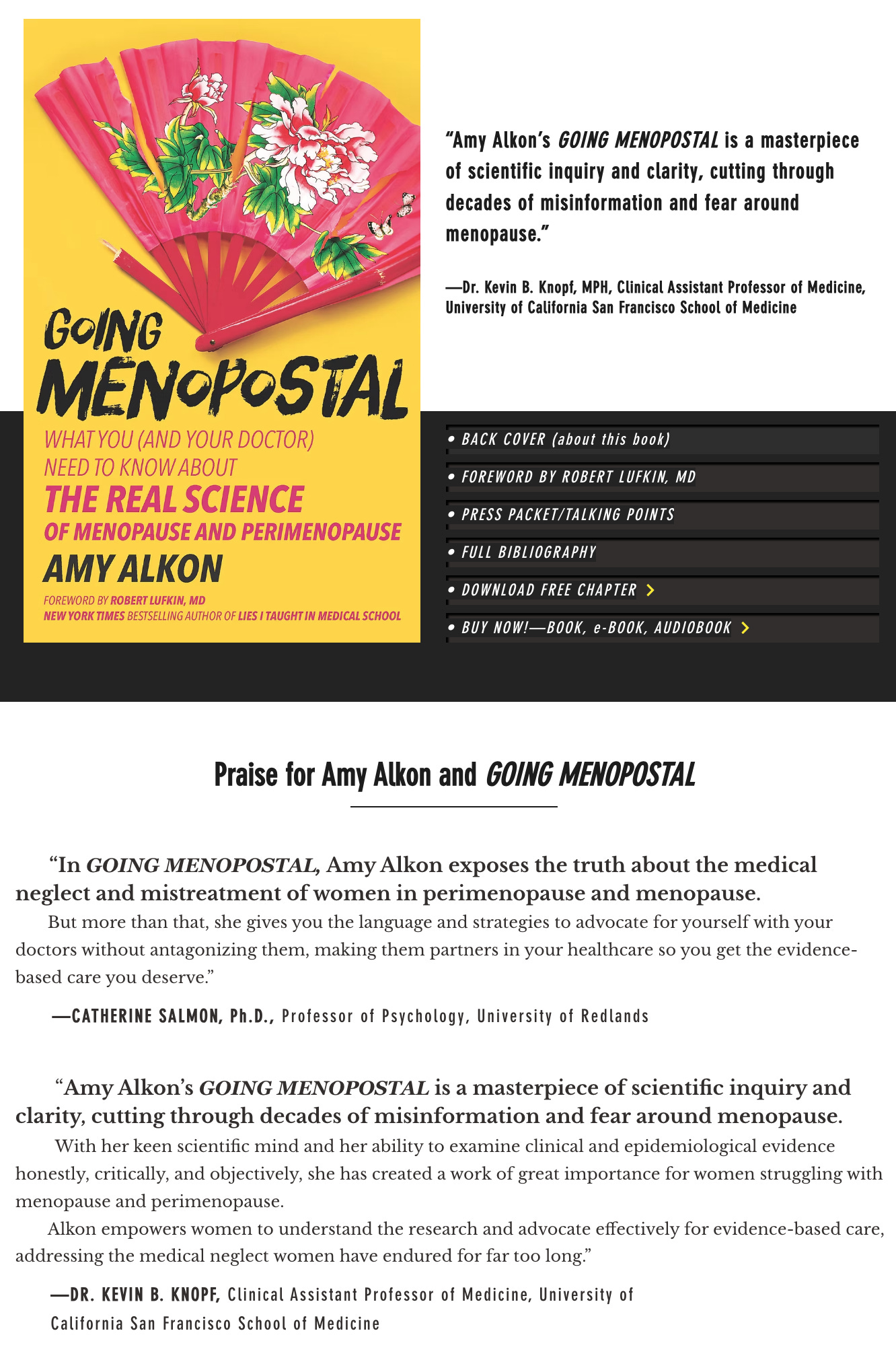
Buy GOING MENOPOSTAL:
What you (and your doctor) need to know about the real science of menopause and perimenopause
“This is a rigorous and meticulous guide to everything related to menopause. … Alkon does a tremendous job of breaking down scientific facts for everyday readers. … Her smart, thoughtful accounts of her own experiences lend a feeling of camaraderie to the book.” —Kirkus Reviews